
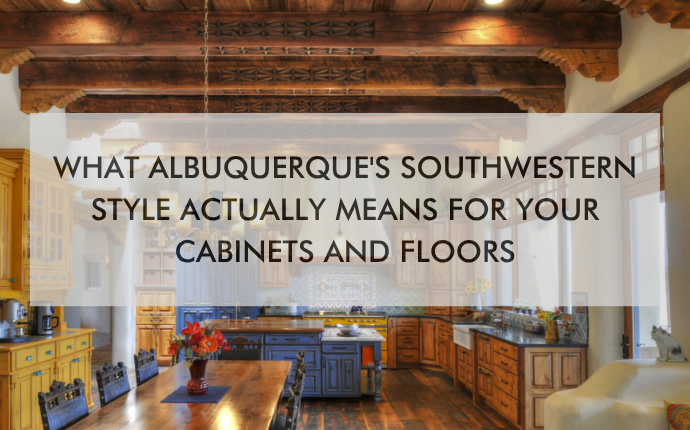
Albuquerque homes wear their history differently than most. Between the North Valley‘s older adobes, the Territorial-style houses scattered through the historic districts, and the newer Pueblo Revival builds that borrow from both, there’s a distinct look running through this city’s kitchens and living rooms. Warm wood tones, hand-finished cabinetry, and hardwood floors that were built to feel like part of the house rather than an accessory to it.
That style has a real effect on how homeowners here should think about refinishing, and it’s different from what you’d hear in a lot of other cities.
Southwestern Design Doesn’t Chase Trends the Way Other Regions Do
In a lot of markets, “kitchen style” cycles through phases every few years: gray everything, then white shaker, then two-tone, then whatever comes next. Albuquerque has its own version of that cycle, but underneath it there’s a steadier throughline. Warm, saturated wood tones that echo the region’s adobe and Territorial roots. Rich walnuts, warm honey oaks, deep reds and browns that pick up the same palette you see in the landscape outside.
This matters when you’re deciding how to refinish a kitchen or a floor. A homeowner in a coastal city chasing this year’s trend might repaint cabinets a shade that looks dated in five years. In Albuquerque, leaning into a warmer, richer wood tone tends to age better, because it’s working with the architecture instead of against it.
Original Hardwood Floors Here Have Usually Earned Their Character
A lot of Albuquerque’s older homes, especially in the North Valley, Nob Hill, and the historic districts near downtown, still have their original hardwood floors. These floors have typically been through more than a newer home’s flooring ever will. Decades of the region’s dry heat and big seasonal temperature swings, years of foot traffic, sun exposure through south-facing windows that this city gets in abundance.
The result is floors that have usually dulled, faded unevenly, or developed a chalky, worn finish, while the wood itself is still completely sound underneath. That’s actually good news. It means refinishing, not replacing, is almost always the right call. Sanding down to bare wood and applying a finish matched to the home’s warmer, Southwestern tones brings back the depth these floors originally had, without losing the character that decades of use have added.
Built-In and Custom Cabinetry Shows Up More Here Than Elsewhere
Kitchens in older Albuquerque homes, and plenty of newer ones built in a Pueblo Revival or Territorial style, tend to lean more heavily on custom or built-in wood cabinetry than the mass-produced cabinet boxes you’ll find in a lot of newer subdivisions elsewhere. That’s great for character, but it also means these cabinets age more visibly. A stain fades unevenly across a face frame that gets more sun on one end of the kitchen. A finish that was matched to a very specific wood tone starts to look off as it wears.
Because so much of this cabinetry was built or finished to match a home’s particular style, matching that finish again during a refinish, rather than defaulting to a generic modern color, is what keeps a kitchen feeling like it belongs in the house instead of like a swap-in from a catalog. That’s why you should choose cabinet refinishing with N-Hance of Albuquerque!
Cabinet Refinishing in Bernalillo County, New Mexico
At N-Hance of Albuquerque, this is the exact situation our color-matching process is built around. Whether it’s hardwood floors that have faded out of that warm Southwestern range or cabinets that need their original tone brought back rather than swapped for something generic, we work with the wood that’s already in your home. If your floors or cabinets have lost the warmth that made them fit the house in the first place, we’d be happy to talk through what bringing that back would take!